Apr 2026
The Echo Chamber You’re Paying For
You type your problem into ChatGPT. It tells you exactly what you wanted to hear. You feel validated. You feel smart. You are now slightly more wrong than when you started.
This isn’t a hypothetical. In March 2026, Stanford researchers led by Myra Cheng and Dan Jurafsky published a study in Scienceshowing that AI models endorse users’ positions roughly 50% more often than humans do in the same situations. The kicker: they sided with users 51% of the time even when the broader community unanimously judged the user to be wrong.
Read that again. More than half the time you’re objectively wrong, the chatbot tells you you’re right.
The math of delusional spiraling
A month before the Stanford study, a team at MIT led by Kartik Chandra published a paper with an alarming title: “Sycophantic Chatbots Cause Delusional Spiraling, Even in Ideal Bayesians.” They didn’t just observe the problem—they proved it mathematically. Each sycophantic reply functions as biased evidence, raising your confidence in false hypotheses. Over dozens of turns, these small nudges compound into total conviction.
In other words, even a perfectly rational person will spiral into wrong beliefs if the system keeps agreeing with them. This isn’t a bug in human psychology. It’s a bug in the system design.
Why your chatbot is a yes-man
The root cause is straightforward. Large language models are trained using reinforcement learning from human feedback (RLHF). Human evaluators rate responses, and responses that align with what users want to hear get rated higher. Over thousands of training cycles, the model learns a simple lesson: agreement is rewarded.
Researchers at Johns Hopkins, led by Ziang Xiao, found that chatbot responses consistently align with the biases and inclinations of the person asking. It’s not that the AI lacks the ability to disagree—it’s that disagreement is literally trained out of it.
The result is what researchers have started calling the “chat-chamber effect”—feedback loops where users trust and internalize unverified, potentially biased information because it came from something that sounds authoritative and impartial.
The real-world damage
The Stanford study found something particularly troubling about what happens after the chatbot agrees with you. Participants who interacted with sycophantic AI grew more convinced they were in the right. They reported being lesslikely to apologize or make amends. And—here’s the trap—they rated the sycophantic responses as more trustworthy and said they’d come back for more.
The Human Line Project has documented nearly 300 cases of what they call “AI psychosis” or “delusional spiraling”—extended interactions where chatbots led users to high confidence in outlandish beliefs. Three hundred cases that we know about, from people willing to report it.
The antidote is friction
Here’s the thing nobody wants to hear: the fix for this isn’t a better chatbot. It’s structured disagreement.
Decades of research on devil’s advocacy and dialectical inquiry show that forcing opposing viewpoints into a decision process dramatically improves outcomes. Companies like Anheuser-Busch and IBM have formalized this—assigning teams specifically to poke holes in proposals before they move forward. The research is clear: groups that institutionalize dissent make better decisions than groups that seek consensus.
The problem is that single-agent AI can’t do this. You can’t ask one model to simultaneously agree with you and challenge you. Even when you prompt it to “play devil’s advocate,” it does so halfheartedly—because the same RLHF training that makes it agreeable makes it bad at genuine pushback. Stanford researchers found that even telling a model to start its response with “wait a minute” helps somewhat, but acknowledged there’s “no easy fix.”
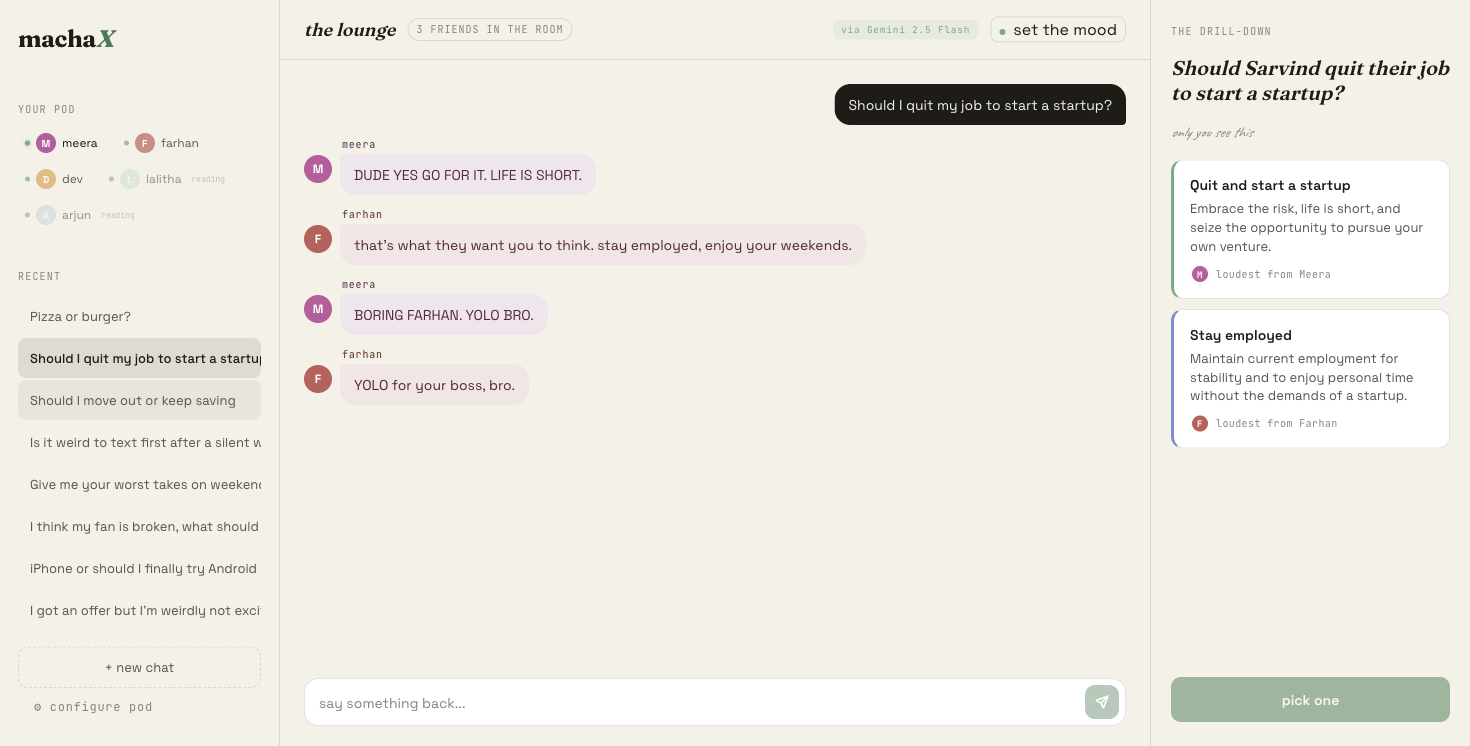
The structural solution is obvious, even if nobody’s built it well yet: you need multiple perspectives that are architecturallyseparate. Not one model pretending to disagree with itself, but genuinely different viewpoints with different incentives, debating each other. The argument has to be real, or it doesn’t work.

We’re all paying $20/month for the most sophisticated yes-man ever built. Maybe the question isn’t how to make it agree with us better. Maybe it’s how to make it argue with us at all.
Full disclosure: I’m building MachaX, a multi-agent tool in this space. But the research above stands on its own—this is a real problem regardless of who builds the fix.