Apr 2026
Your Brain Already Has Multiple Agents (You Just Can’t Hear Them)
You think you’re one person making one decision. Neuroscience disagrees. Your brain is a noisy committee—and the loudest member usually wins, not the smartest one.
There’s a reason “I’m of two minds about it” is a universal expression. It’s not a metaphor. It’s closer to a neurological description than most people realize.
The society inside your skull
In 1986, Marvin Minsky—the MIT cognitive scientist and AI pioneer—published The Society of Mind, arguing that human intelligence isn’t a single thing but a vast society of individually simple processes he called “agents.” These agents are the fundamental thinking entities from which minds are built. None of them is intelligent on its own, but together they produce everything we attribute to consciousness.
Minsky’s key insight was that different agents are based on different types of processes, with different purposes, different ways of representing knowledge, and different methods for producing results. Your risk-assessment agent doesn’t work like your creativity agent. Your empathy module runs on different hardware than your logic module. They’re not one system with different modes—they’re different systems that happen to share a skull.
System 1 vs. System 2 (and all the others)
Daniel Kahneman popularized the most famous version of this idea with System 1 (fast, intuitive, automatic) and System 2 (slow, deliberate, analytical) in Thinking, Fast and Slow. But even Kahneman acknowledged this was a simplification. Keith Stanovich and Richard West, who coined the System 1/System 2 terminology, described the brain as having two fundamentally different processing architectures that can reach contradictory conclusions about the same input.
The neuroscience backs this up. Research has linked System 2 decision-making with circuits centered on the prefrontal cortex, while System 1 engages different circuits running through the dorsolateral striatum. These aren’t software modes— they’re different neural pathways that literally compete for control of your behavior.
And two systems is probably still too few. Michael Gazzaniga, the neuroscientist who pioneered split-brain research, identified what he called the “left-brain interpreter”—a module that constructs post-hoc explanations for decisions your brain has already made through other processes. You feel like a unified decision-maker, but that’s because the interpreter is retrospectively narrating a story of coherence over what is actually a messy committee process.
Parts therapy and the wisdom of inner conflict
Richard Schwartz (no relation to the paradox-of-choice Schwartz) built an entire therapeutic framework around this idea. Internal Family Systems (IFS) therapy treats the mind as containing multiple “parts”—each with its own perspective, its own fears, its own agenda. There’s the protector that avoids risk. The exile that carries old pain. The firefighter that acts impulsively to distract from discomfort.
IFS doesn’t try to silence these parts. Its core principle is that healthy functioning comes from letting all parts be heard while a calm, centered “Self” acts as the leader of the system. The problem isn’t having multiple voices. The problem is when they argue in the dark and the loudest one hijacks the process.
Neuroscience researchers have drawn connections between IFS and the process of memory reconsolidation—the idea that by simultaneously activating an emotional memory while creating a contradictory experience of safety, you can permanently revise the neural networks involved. In other words, the therapeutic effect comes from making the internal debate explicit.
The CEO who doesn’t know he has a board
Physicist Michio Kaku used a corporate analogy for the brain that I find weirdly useful: the conscious mind is like a CEO who thinks they run the company alone, unaware that a board of directors, middle managers, and hundreds of workers are making decisions all around them. Gazzaniga’s interpreter module is the CEO— narrating coherence over chaos.
Here’s what this means for decisions: when you’re agonizing over whether to take the new job or stay put, you’re not one person weighing pros and cons. You’re a coalition of subsystems with conflicting interests. The risk-averse part wants stability. The growth-oriented part wants novelty. The status-conscious part is thinking about what your parents will say. The creative part is imagining the possibilities.
They’re all running simultaneously, at different volumes, without taking turns. No moderator. No structured debate. No synthesis. Just a cacophony that your interpreter module papers over with whatever narrative feels most coherent.
Making the debate visible
The consistent finding across all of these frameworks—Minsky, Kahneman, Gazzaniga, IFS—is the same: you make better decisions when the internal debate becomes external. When the competing voices get explicit names, explicit arguments, and an explicit process for resolution.
This is why journaling works. Why therapy works. Why talking to a smart friend works. They all do the same thing: they take the silent committee in your head and give it a stage, a microphone, and a moderator.
The question I keep coming back to is: what would it look like to do this on demand? Not journaling, which requires you to articulate what you don’t yet understand. Not therapy, which requires scheduling and $200/hour. Not a friend, who has their own biases and isn’t available at 3am. Something that takes the committee in your head, makes it visible, and lets you watch the argument play out before you pick a side.
Your brain is already running a multi-agent system. You just can’t see the transcripts.
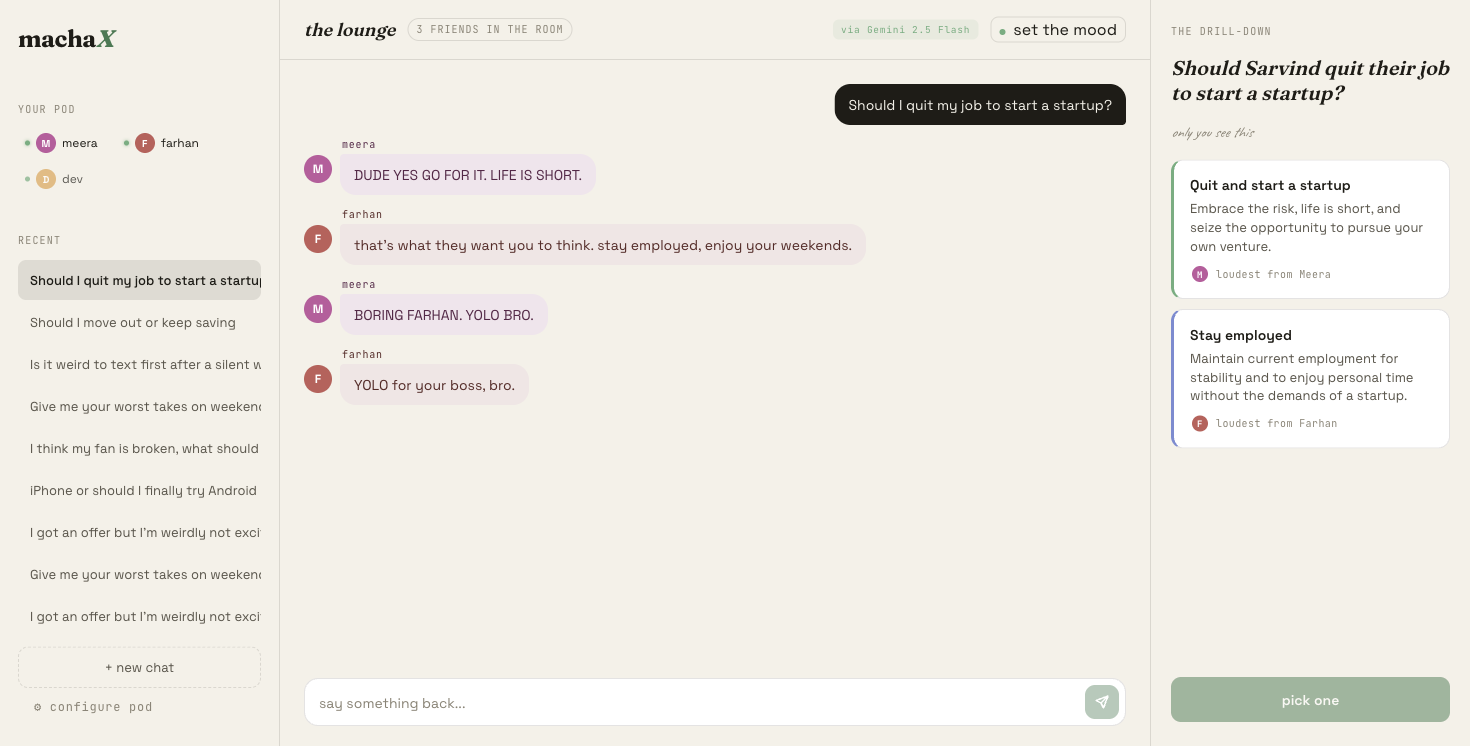
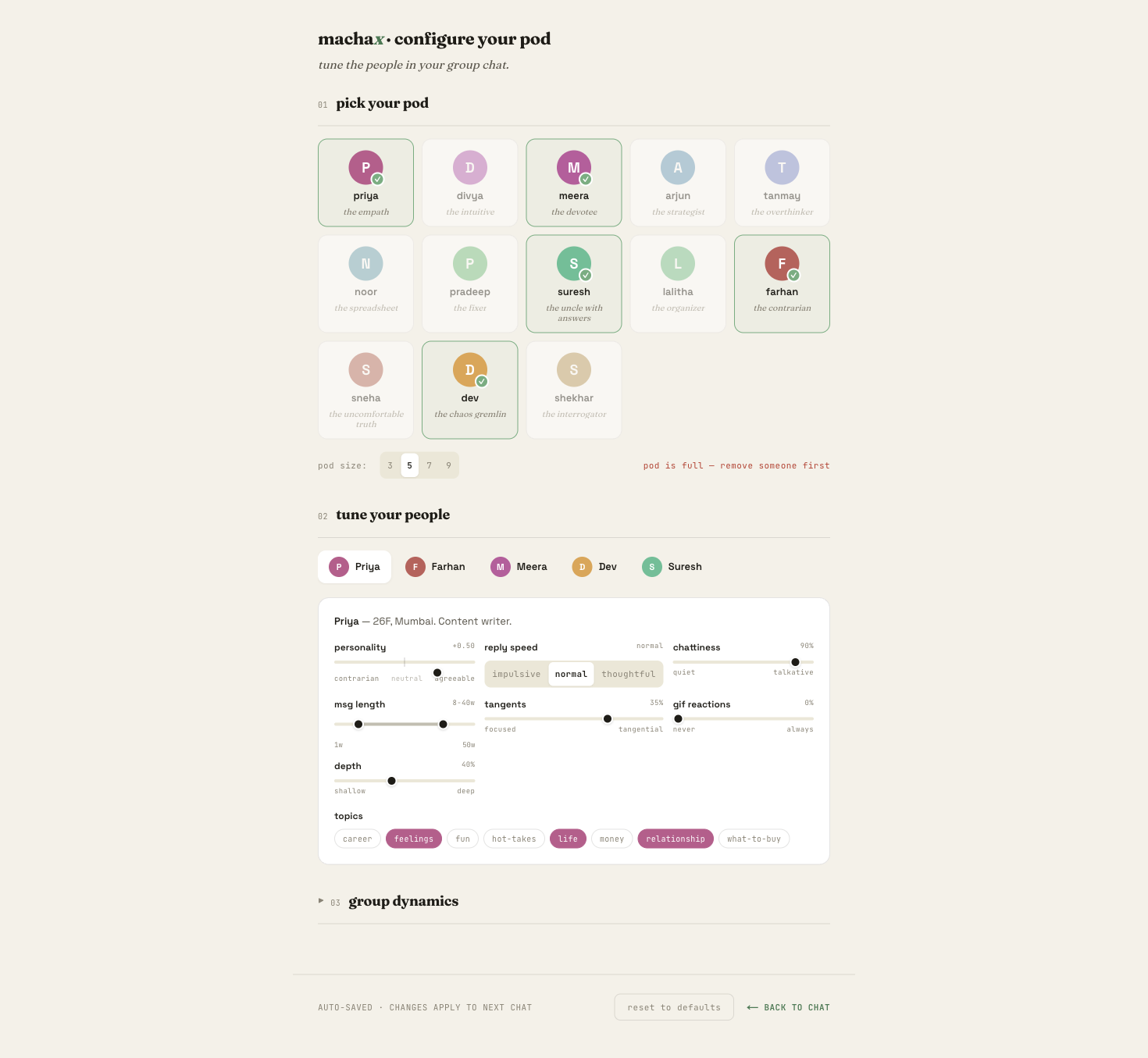
Full disclosure: I’m building MachaX, which is one attempt at making this kind of internal debate external and structured.