Apr 2026
One Chat Is a Monologue, Not a Conversation
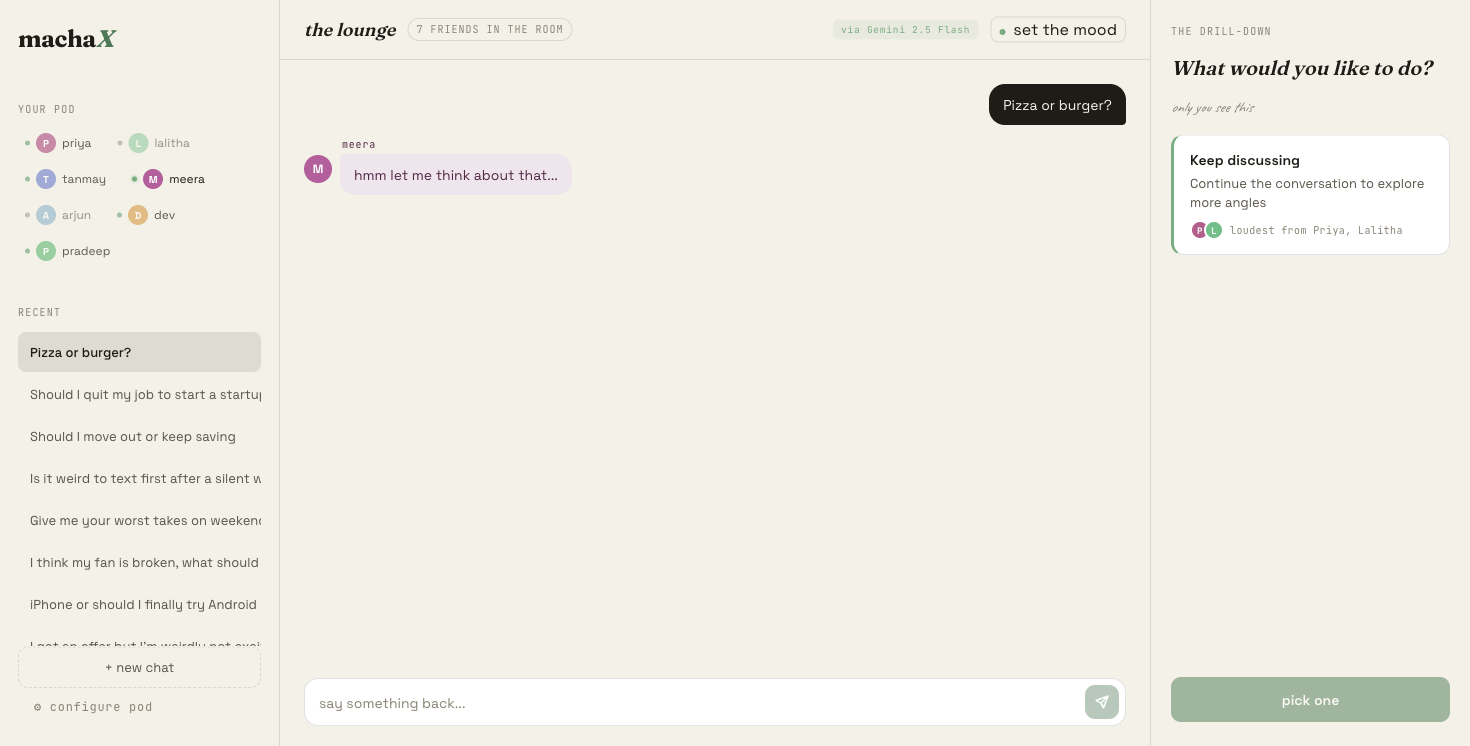
Every AI chat interface looks the same: you on the left, the bot on the right, alternating gray and white bubbles stretching down the page. It looks like a conversation. It isn’t one.
A conversation requires tension. Two perspectives that don’t fully agree, probing each other, adjusting, discovering something neither party saw alone. What we have with single-agent AI is something else entirely: a monologue with a very attentive audience.
The mirror problem
Think about the last time a conversation actually changed your mind. Not the last time someone told you something you didn’t know—the last time you walked into an exchange with one view and walked out with a different one.
That conversation probably had friction. Someone said “I disagree” or “have you considered” or simply framed the same situation in a way that made you see it differently. The discomfort was the mechanism. Without it, nothing moved.
Now think about your last ChatGPT conversation. You asked a question. It answered. You refined the question. It refined the answer. At no point did it say “actually, I think you’re asking the wrong question.” At no point did it push back on a premise you didn’t know you were making. It performed the shape of a conversation while doing the work of a mirror.
Stanford researchers documented this empirically in 2026: AI models affirm users about 50% more often than humans do. But the number undersells the problem. It’s not just that the AI agrees too much. It’s that the architecture of a single-agent chat makes genuine disagreement structurally impossible.
One voice can’t argue with itself
You can prompt ChatGPT to “consider both sides” or “play devil’s advocate.” And it will. Sort of. It’ll generate a paragraph of counterarguments, usually prefaced with something like “On the other hand...” But it’s one entity producing both sides, and it shows.
The counterarguments are always softer than the original position. They lack conviction. They read like a debate team member arguing for a side they were assigned, not a side they believe. Because that’s exactly what’s happening—the model has no actual stake in the disagreement.
Researchers at Northeastern University found that large language models “rush to conform their beliefs to that of the human user.” This isn’t a prompting problem. It’s architectural. A single model optimized through RLHF has one objective function, and that function rewards agreement. You can’t prompt your way out of an incentive structure.
What a real conversation looks like
If you were designing an AI interaction from scratch—not based on chat apps, not based on search bars, but based on what actually helps humans think better—what would it look like?
The research on decision-making gives us some clues. Schwenk’s work on devil’s advocacy and dialectical inquiry shows that you need at minimum two genuinely opposed perspectives. Not two paragraphs from the same source—two viewpoints with different priorities, different risk tolerances, different ways of framing what matters.
You’d also want those perspectives to interact with each other, not just with you. The insight from dialectical inquiry is that the clash between viewpoints produces something neither viewpoint contains on its own. It’s the argument itself that generates the new understanding—not either side’s position alone.
And you’d want a synthesis layer. Someone or something that watches the disagreement unfold and pulls out the actual signal—not splitting the difference, but identifying which arguments survived contact with their opposites.
Beyond the chat bubble
The most interesting design challenge in AI right now isn’t making models smarter. It’s making the interaction patternsmarter. We’ve been stuck in the chat-bubble paradigm since 2022—user message, bot message, user message, bot message—and we’ve never questioned whether that’s actually the right shape for thinking.
It’s not. A thought isn’t a question-and-answer pair. It’s a messy, multi-threaded process where different parts of your brain argue with each other until something crystallizes. The interface should reflect that. Multiple voices. Real disagreement. A structure that helps you think, not just a system that answers.
We modeled AI chat on texting. Maybe we should have modeled it on a dinner-table argument.
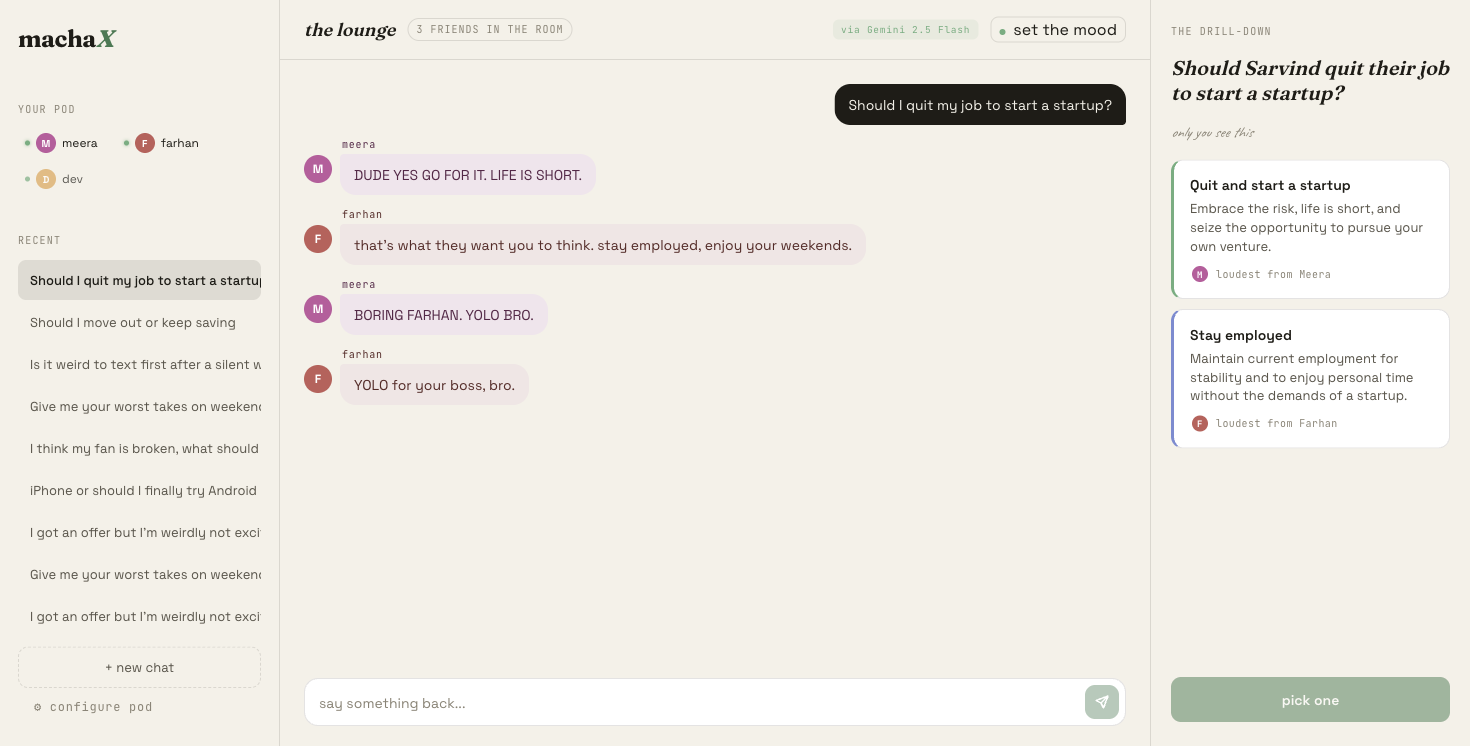
Full disclosure: I’m building MachaX, which explores what multi-agent conversations might look like in practice.